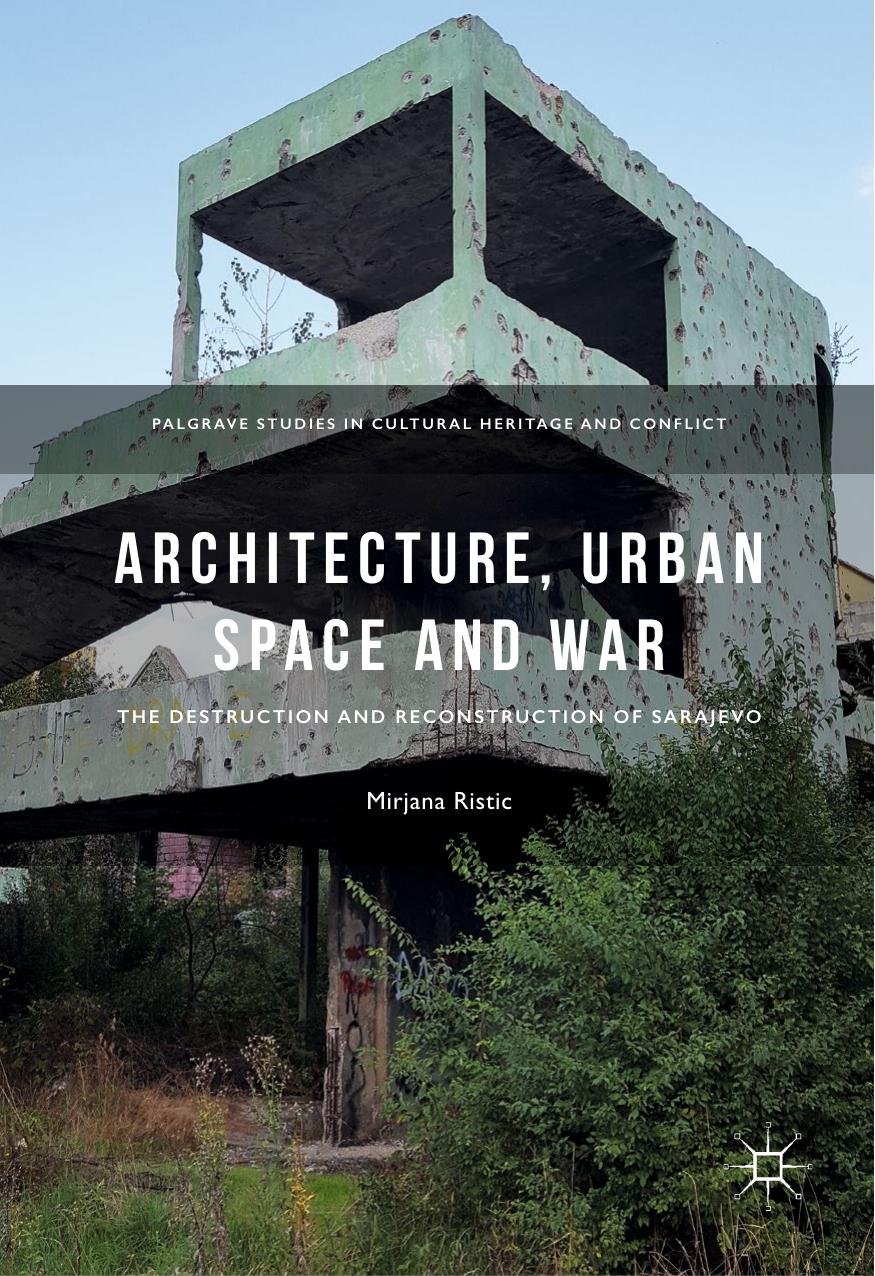
Architecture, Urban Space and War by Mirjana Ristic
Author:Mirjana Ristic
Language: eng
Format: epub, pdf
ISBN: 9783319767710
Publisher: Springer International Publishing
Insurgent Place-making as a Tool for the City’s Defense
In Chaps. 3 and 4, I discussed how the BSA appropriated the city’s micro-geography and urban morphology into tools of terror and violence. In this chapter, I have demonstrated how civilians appropriated buildings and public spaces and adapted everyday spatial practices as weapons of the city’s wartime defense. The BSA military strategy of urban violence and terror was an effort to break down the city and push it to surrender (Bassiouni 1994), but it generated an inverse effect as citizens and architects produced new spatial mechanisms of resistance. They defied the city’s physical and spiritual annihilation through adaptation and reuse of its spaces, construction, creation and imagination for its future development (Pirnat-Spahić 1993).
Novel spatial organization of the city, patterns, rhythms and practices of everyday urban life, meanings and experiences of place have emerged. Through them, the city as a socio-spatial assemblage was reconstituted through different spatial levels and scales. What Weizman (2007) refers to as ‘the politics of verticality’ was mediated through how military violence and civilian resistance were juxtaposed across a three-dimensional space. The city was besieged and targeted from above, while also being protected from below. The exposure of the city’s buildings and spaces to the army’s panoptic gaze from the surrounding hills was confronted through the production of new morphologies of enclosure—underground and subterranean spaces (tunnels and trenches), cultural shelters, interstitial public spaces (staircases), protective walls and ‘urban interiors’. The city’s wartime everyday life split into several dimensions—from the extremely dangerous overground city and outdoor public spaces, where urban life was reduced to necessity, to the safer indoor spaces and underground city where people gathered and mixed (Pilav 2012).
Civilian practices of resistance were material, discursive and experiential. Erecting visual barriers against snipers to access the city’s wartime markets played a crucial role in physical survival. Adaptation of places into wartime cultural spaces offered a channel for psychological survival against the surreal conditions during the war. Architects’ drawings and international exhibitions were a means of communicating with broader international audiences both to raise awareness about the city’s destruction during the siege and to disseminate knowledge about the creativity of ordinary people in resisting violence and terror.
Residents’ resistance against the siege operated as what Deleuze and Guattari (1987) refer to as an autonomous ‘war-machine’—a socio-spatial assemblage of people, places, and practices that subverted the BSA’s military power. The practices of violence and terror “destroyed the hardware of civilization” (FAMA 1993: Preface)—buildings, networks, flows, systems of infrastructure, etc. The city became a ‘striated space’ (Deleuze and Guattari 1987) fragmented into bounded zones. Residents ‘smoothed’ it out through what can be termed insurgent place-making practices that defied a stable socio-spatial hierarchy—the ethnic division of Sarajevo. They led a form of architectural and urban guerrilla warfare in which they took on the role of nomadic fighters who appropriated everyday spaces and objects as tools of the city’s wartime resilience. They also took on the role of self-taught architects who mobilized the capacity of spatial
Download
Architecture, Urban Space and War by Mirjana Ristic.pdf
This site does not store any files on its server. We only index and link to content provided by other sites. Please contact the content providers to delete copyright contents if any and email us, we'll remove relevant links or contents immediately.
Kathy Andrews Collection by Kathy Andrews(11832)
The remains of the day by Kazuo Ishiguro(8999)
Spare by Prince Harry The Duke of Sussex(5197)
Paper Towns by Green John(5191)
The Body: A Guide for Occupants by Bill Bryson(5097)
Industrial Automation from Scratch: A hands-on guide to using sensors, actuators, PLCs, HMIs, and SCADA to automate industrial processes by Olushola Akande(5061)
Machine Learning at Scale with H2O by Gregory Keys | David Whiting(4313)
Be in a Treehouse by Pete Nelson(4051)
Never by Ken Follett(3957)
Harry Potter and the Goblet Of Fire by J.K. Rowling(3857)
Goodbye Paradise(3810)
The Remains of the Day by Kazuo Ishiguro(3413)
Into Thin Air by Jon Krakauer(3399)
Fairy Tale by Stephen King(3399)
The Cellar by Natasha Preston(3344)
The Genius of Japanese Carpentry by Azby Brown(3309)
120 Days of Sodom by Marquis de Sade(3275)
Reminders of Him: A Novel by Colleen Hoover(3121)
Drawing Shortcuts: Developing Quick Drawing Skills Using Today's Technology by Leggitt Jim(3081)
